Update 2.1.0 is out: transport, money and the law
Trains, ports, airports, military bases, jobs, money and the law in walk mode — and the game now speaks 17 languages.
An atlas of the Earth and the stars
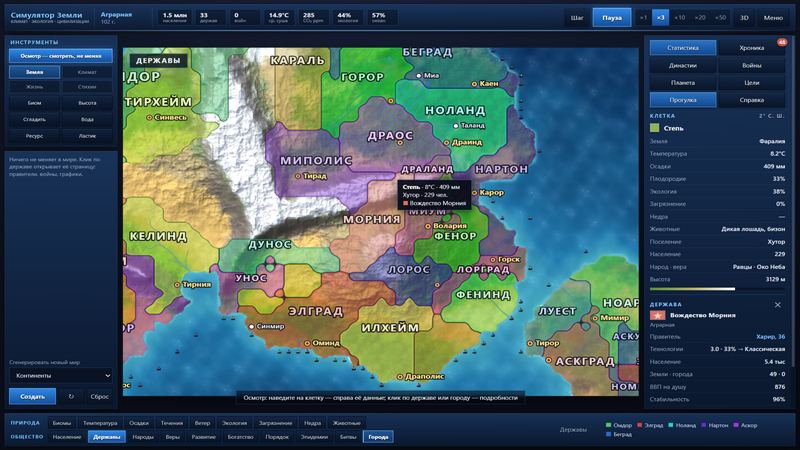
Simulator of the Earth
A planet sandbox where climate, nature and civilisations live on their own. Here is the game’s star map — from the first tribes to the galaxy — a chronicle of versions and a field journal from development.
Hold the mouse over the map to raise land. With Shift — to lower it.
You set the terrain, winds, currents and climate, and then the world lives on its own. Rivers find their way to the sea; deserts and forests settle into their latitudes. Tribes grow into states that trade, wage war, change dynasties and reach for space. At any moment you can step down to the ground and walk the world in first person.
Evaporation and wind-borne moisture, monsoons and rain shadows, ocean currents, ice sheets and the greenhouse effect. Nineteen biomes and thirty-five animal species that migrate, die out and end up in herds.
Six eras, from tribes to space. Ten forms of government, dynasties with family trees, wars, fleets, colonies and nuclear weapons. Every state keeps its own chronicle.
Any cell on the map is a place you can step into. Cities of their era, locals with names and families, weather, day and night, weapons and vehicles.
Every update is a star system, and every new feature is a planet on its orbit. Shining planets are already in the game, teal ones are in progress. Hover a system to see what it rests on, and click it to open the details. Dates are approximate.
The global update where it all began: new graphics, first-person walks anywhere on the planet, dynasties, a chronicle and detailed statistics.
Evaporation, winds, monsoons, rain shadows, ocean currents, ice sheets and CO₂.
19 biomes and 35 animal species: extinction, migration and domestication.
Six eras, ten forms of government, wars, fleets, colonies and nuclear weapons.
Family trees, rulers’ traits and skills, elections, coups and wars of succession.
In any cell of the world: weather, day and night, locals, vehicles and weapons of the era.
Terrain, dynamic water, day and night; music adapts to the era.
An in-game mod editor: maps from images, scenarios, animals, models and balance.
The world gained railways, ports, airports and military bases, and walk mode gained jobs, money, law and quests from the locals. The game now speaks 17 languages.
From steam engines to maglev: ride as a passenger, steal a locomotive or work as a driver; cabs and coaches inside.
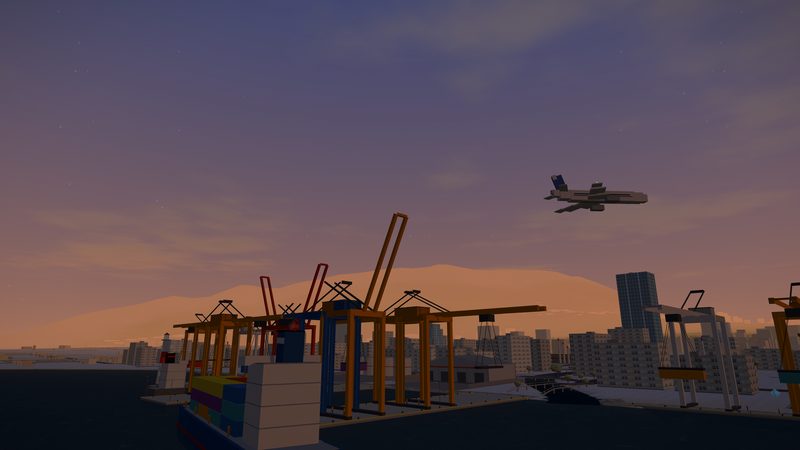
Fly as a passenger to other airports of the world, work as a pilot; hijackers get intercepted — time for the parachute.
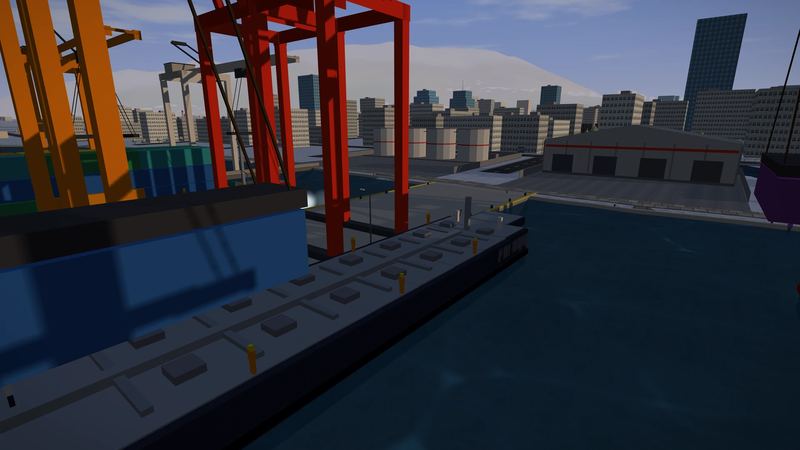
Merchant ships arrive and depart; walk the deck, work at the docks and talk to the crew.
Fleets, blockades and landings — watch from the shore or from the deck.
From a stockade to a base of the future: service, guard duty, stealing tanks and planes.
State currencies — from hides to credits — side jobs, shops and a reputation you can mend.
A guarded ruler in a palace, wanted levels up to five stars, police cars, fines and pardons.
Quests born from world events: famine, plague, bandits, war, harvest.
Chinese, Japanese, Korean, German, French, Spanish, Portuguese, Polish, Turkish, Italian, Ukrainian, Czech, Thai, Vietnamese and more.
Rename states, cities, rulers, dynasties, peoples and faiths; draw your own flag for any state. Players’ idea.
Any action on any key; in-game hints show your keys.
On foot you see exactly what a state has reached: its animals, vehicles, weapons and buildings, and towns move into a new era gradually, house by house. Houses can be destroyed, Survival mode gets hunger and thirst, and walk mode gets new weapons and healing. Disasters get real scales and lasting marks, seas get ice, the map gets new colours and more information.
Horses and carts only after taming and the wheel; where there are no horses — camels, llamas or reindeer. Swords, ships, signs and buildings follow the state’s inventions; fields get oxen ploughs, reapers or combines; no sailing ships in the age of skyscrapers. Players’ idea.
A town enters a new era house by house, and its streets cart by cart: old buildings and old vehicles stand beside new ones instead of all changing at once.
Battles use the same tanks and vehicles as the state’s bases, with trenches, hedgehogs and dugouts; steal vehicles off the battlefield, and those who fall by your hand are subtracted from the army on the map. Players’ idea.
A tank, a blast or a fire turns a house into ruins; where the map burns, walk mode shows fire and smoke; ruins look like rubble and burnt frames, not dark boxes.
In Survival mode you need to eat and drink, and heat and cold follow the local climate; Standard mode stays relaxed. Players’ idea.
Grenades, shotguns and sniper rifles; herbs, bandages and medkits — by era. Players’ idea.
A window for every trade route: who trades with whom, how much and what they carry.
Airships over industrial-era cities, and later pleasure balloons over the fields and advertising blimps; you can steal those too.
Disaster cards on hover, real-world scales — Saffir–Simpson, VEI, magnitude, kilotons — and craters that fill with water and heal over. Players’ idea.
Ice blocks ships and straits freeze by season, while epidemics cross the sea aboard ships. Players’ idea.
Pin not just temperature but rainfall, sea level, CO₂ — and release them; a river brush: draw a channel and the water finds its way to the sea.
Toggle icons of cities, bases and ports, temperature anomaly since the start, new colours and a colour-blind mode, search for states and cities. Players’ idea.
Shops: the healer sells herbs, bandages and medkits, the gunsmith grenades and new weapons; in Survival mode food and water truly matter.
Battles: a destroyed house stays in ruins, and soldiers who fall by your hand are subtracted from the army on the map.
Become the ruler of any state. Lead it from the map like a strategy game — or go down to the palace and rule in first person: hear your counsellors, receive envoys, issue decrees from the throne. Your state lives in the same world as the others, by the same rules — but the big decisions are yours.
Pick any state and lead it from the map: war and peace, alliances and vassals, the main thrust, moving the capital. Pause the game to think things over. Players’ idea.
Expansion, development, army or faith: the course decides where the state spends its strength — and you see what it does to it.
A throne room in the palace: take the throne, receive visitors and issue decrees right in the world. Players’ idea.
A general, a treasurer, an envoy and a priest report on the state’s affairs and give advice — whether to listen is up to you.
Other states send envoys: an alliance, peace, tribute or an ultimatum. The answer is yours, and the neighbours will remember it.
When the ruler dies you play the heir from the same dynasty shown in the family tree.
A lost war, famine or a foreign faith can turn into a revolt or a coup — and you will have to hold on to the throne.
The first buildings with doors: palace, house, tavern, shop and temple — each era and culture its own. Players’ idea.
Your wars, alliances and reforms go into the state’s chronicle; your reign earns achievements of its own.
The palace and guards from 2.1 become yours: the watch guards you, and conspirators come for you.
Walk mode: step out of the palace into your capital — where people know who you are.
Roads on foot match the map, highways link cities, and buses and lorries run on them. Borders follow ridges and rivers, with checkpoints. The sky gets air battles and the flying cars of the future. Cities look the way their climate, people and faith make them. And the law gets prisons — with pirates on the sea lanes.
Roads, highways between cities and railways on foot match the world map; every line has its stations.
City and intercity routes: ride as a passenger or work as a driver.
Lorries carrying cargo between cities — and a trucker’s job.
State borders follow ridges and rivers instead of cutting mountains in half.
At the border — a barrier, border guards and a check of papers.
Air and combined battles — sky, land and sea; from biplanes and bombers to aircraft of the future.
Adobe and sandstone in deserts, log houses in the taiga, stone in mountains, stilts in marshes, yurts on the steppe; temples, shrines, totems, roofs and ornament by people and faith. Players’ idea.
In the era of the future cars really fly — over streets and between cities. Players’ idea.
From a pit and a stockade to a prison with towers: serve your time and the wanted level clears, or escape and it grows. Players’ idea.
You can rob a shop or a caravan, but guards, witnesses and the wanted level make it a gamble, not a living.
Lone pirate ships on the trade lanes; sign on with them or raise the black flag on a stolen ship. Players’ idea.
Jobs: bus driver and long-haul trucker beside train driver and pilot.
Law: border guards ask for papers, smuggling becomes a crime, and instead of an instant fine there is prison — which you can escape.
Rebuild the engine for the big plans: the world becomes a globe, the simulation fast and predictable, the code ready for networking and other planets.
The map wraps east–west, cell areas follow latitude, and 3D shows a real planet from orbit.
The Earth map is built from real land and ocean-floor elevation data.
The UI and walk mode stay smooth; speeds of ×100 and beyond.
Maps up to roughly 500×250 cells, resized without restarting the game.
One seed, one history: replays, reproducible bugs and the basis for multiplayer.
Technologies, buildings, vehicles and goods live in tables that mods can reach.
Jobs, professions, shops and quests are described by conditions: era and knowledge, climate, laws, wealth, war. New updates add conditions without rewriting the mechanic.
Old worlds migrate automatically, however many versions later.
A fresh three.js: atmospheric scattering, foamy water, soft shadows, colour grading.
The dictionaries already came out in 2.1 — players will be able to fix translations and add new languages through the Workshop.
A simplified simulation for weak PCs and a full one for strong PCs — chosen in settings, like graphics quality.
Pressure, cyclones and clouds arise from moisture and wind; a new map layer shows pressure.
Jobs, shops and quests from 2.1 move onto data rules — from then on every update adds conditions without rewriting the mechanic.
Sea trade and wars span the globe: ships sail around the world instead of hitting the map edge.
Instead of a single ‘technology’ number — a tree of discoveries with no ceiling, and with it living languages, cultures and faiths. States take different paths, and space is just one road, not everyone’s finish line.
About 150 known discoveries in six branches — economy, crafts, seafaring, warfare, science, society — and beyond them new ones that never existed in our history.
The Middle Ages and the early modern era between antiquity and industry, and an age of world wars — first tanks, rifles, biplanes, prefab blocks — before the modern era. Players’ idea.
Steppe folk tame the horse first, islanders master the sea first.
For any state: what has been learned, what is being studied and what comes next. Players’ idea.
Through trade, war, migrants and spies; technologies can be lost in dark ages.
Clothing, crafts, goods, professions, vehicles and houses follow the tree of knowledge: a new discovery gradually changes what you see in the streets — learn the engine, and the first cars appear among the carts.
Herds provide food, wool and draught power, while riding, chariots and nomadic herding become discoveries in the tree.
States find ore, coal and oil — offshore oil too — only once they know how to search for and mine them; until then deposits stay hidden.
Roads, rails and ports become a real network carrying trade and migrants, and later cargo and armies. Today they are only decoration.
Language families and dialects: names of towns and people come from the language, change over time and are borrowed from neighbours.
Peoples split and merge, and take up customs from neighbours and conquerors.
Faiths split into branches, reform and fade — each with a history of its own.
A state knows only those it has met: neighbours and those its ships and caravans have reached; it can trade and fight only with the known.
Jobs and shops: professions and goods unlock with discoveries — the smith with metallurgy, the mechanic with the engine.
Military bases and vehicles: equipment strictly by what the state knows.
Every inhabitant is a person with a fate of their own: a name, family, job, daily routine, memory and story.
Every inhabitant has knowledge and skills, moods, fears and dreams that drive what they do.
Far away — cell statistics, closer — families and neighbourhoods, nearby — living people; someone you meet stays in the world for good.
Houses, ships, swords and medals remember who made them, who owned them and what they went through.
Work, home, market, tavern, temple; feasts, weddings and mourning.
Locals remember your help and your wrongs, and rumours about you spread through town.
Like rulers have today: birth, marriage, trade, moves and wars.
Interiors for every building, from huts to factories — where people live, work and celebrate. Players’ idea.
Hunger and thirst from 2.2 grow into full survival: fatigue, illness, injury and healing. Players’ idea.
Hunting, foraging, cooking and simple crafting.
Build a house, a shop or a workshop with your own hands — and it becomes part of the town.
Trades depend on the era, climate and place; the player gets a career instead of odd jobs.
Quest chains whose consequences show up in the town and the state.
Diseases with strains and carriers, quarantines, healers and vaccines. Players’ idea.
Low-poly characters with faces and animation; clothing by culture, climate and wealth.
Quests come from the needs of specific people, not from a list.
What you do on foot changes the town: help, crime and trade affect its wealth and order.
Join any state and rise from commoner to ruler. Gods and ideologies start to matter.
Feudalism, liberalism, democracy, socialism, communism, centrism, theocracy, dictatorships — with strengths and weaknesses. Players’ idea.
Taxes, conscription, free speech, religion, trade; factions fight for influence.
Join any nation: a home, a post, taxes and protection. Players’ idea.
A coup under feudalism, elections in democracies, the party ladder in one-party states. Players’ idea.
Peasant, merchant, general, prophet, chieftain or king — play as anyone. Players’ idea.
What you build with your own hands grows into a settlement, and the settlement into a state on the map. Players’ idea.
Strike often with lightning and a Thunder God cult is born; droughts, miracles and wrath create pantheons, prophets and heresies. Players’ idea.
Alliances, trade agreements, non-aggression pacts and borders as real documents.
Jobs and law: ideology and laws decide which trades are allowed, who pays taxes and what counts as a crime.
Money: currencies and prices depend on the state’s policies.
The ruler from 2.3 gets new decisions: laws, ideology, dealing with parties.
An economy of real goods, prices and companies, where booms and crises emerge on their own.
Grain, timber, ore, metal, cloth, fuel, machine tools, electronics.
Prices from supply and demand; cargo moves by caravan, ship, train and truck.
Private and state-owned — in farming, mining, industry, trade and transport: hiring, competition, bankruptcy; they drive the state’s economy. Found your own on foot or as a ruler.
Credit, inflation, currencies, shares and dividends.
Bubbles, panics, depressions and hyperinflation — consequences, not dice rolls.
Taxes and spending on army, science, roads and people — in the player-ruler’s hands.
Jobs become employment: vacancies and wages come from the labour market, employers are real companies.
Shops and ports trade goods from supply chains at regional prices.
Armies that march, ride and need supplies — instead of soldiers appearing right on the battlefield.
On foot, horseback, carts, trains, trucks and helicopters — by era and road. Players’ idea.
Front lines, fortresses, trenches and dugouts, sieges and occupation.
Depots and supply trains; losses to hunger, frostbite and heat. Players’ idea.
Resistance, rebels with armies of their own, the struggle for hearts and minds. Players’ idea.
Commanders’ skills, army composition and terrain decide battles.
Not just casualties: a hill held, a banner saved or a fallen general change the outcome of the battle on the map.
Like an RTS: the ruler leads the armies — routes, sieges, landings.
Military bases and service connect to real armies: conscription, supply, deployment to the front.
Naval battles and landings become part of the war’s logistics.
One world for several players — over the internet and on a local network.
A dedicated server for big worlds and LAN play with friends.
Several gods in one world, rulers of states, citizens and travellers.
Co-op sandbox, rival gods, diplomacy between states, a role-play server.
Who may change what; votes on pausing and the speed of time.
Steam invites, chat, community servers.
For powerful PCs: WebGPU, physically based materials, volumetric clouds, dense vegetation.
The economy, laws and wars work for several players at once.
A planet that lives for millions of years: plates drift, mountains rise and erode, and real ores lie deep below.
Years ↔ millennia ↔ millions of years; a fast geological mode.
Continental drift, rifts, mountain building; volcanoes and quakes at plate boundaries.
Rivers carve valleys and build deltas; real lakes appear.
Crust, mantle and core; ore deposits form by geology and run out.
Descend into a mine: tunnels, digging, ore extraction.
Resources: from random patches to geology; miner and geologist become professions.
Volcanoes and earthquakes happen at plate boundaries, with real-scale strength.
Species emerge, adapt and die out on their own — and intelligence can arise in any of them.
Selection and speciation by biome: islands and continents give rise to new branches of life. Players’ idea.
An interactive family tree of species, from the first to the living.
Design your own species and release it into the world.
From a herd grazer to the apex predator.
Any species can become sapient and found a civilisation.
Viruses mutate and jump between species. Players’ idea.
Hunting, taming and herding work with living species populations.
Epidemics: diseases evolve together with their hosts.
Your planet becomes one of many: orbits, neighbouring worlds, terraforming and colonies.
Orbits, day length, axial tilt, moons and tides.
Radius, gravity, atmospheric composition and pressure — the climate adapts on its own.
Create planets from scratch: size, land and oceans, atmosphere, life — and see what grows from it.
Melt the ice caps, give a barren planet an atmosphere, crash a moon.
Rockets, satellites, stations, a flight to the Moon and landings on other worlds. Players’ idea.
Settlements on other planets with histories of their own.
Climate is computed from the planet’s parameters and orbit.
The economy goes to space: off-world mining, space professions.
A galaxy you create — and the civilisations that settle it.
Stars, exoplanets and nebulae; create your own systems.
Generation ships and engines of the future.
First contact, trade, wars and alliances between worlds.
In multiplayer, every player gets a star system of their own.
Trade, diplomacy and wars — between worlds.
Every update since the Steam release, from the development news. On top is what’s being prepared.
The game in 17 languages: Chinese, Japanese, Korean, German, French, Spanish, Portuguese, Polish, Turkish, Italian, Ukrainian, Czech, Thai, Vietnamese and more.
Railways and stations: trains from steam to maglev, passenger rides, locomotive hijacking, train-driver jobs.
Airports: fly as a passenger to other airports of the world, work as a pilot, hijack a plane, interceptors and the parachute.
Seaports, 14 kinds of ships with walkable decks and crews, dock work, naval battles from the shore and from the deck.
Military bases of every era: enlisting, guard duty, stealing tanks and planes.
National currencies, side jobs, shops, quests from locals, reputation and how to mend it.
The law: a guarded ruler in a palace, wanted levels up to five stars, police cars.
On the map: railways, sea lanes, ports, airports, bases and naval battles; a battle window.
Your own names and flags for nations, key rebinding, a Credits section.
The Esc menu always opens again — before, with a state hovered or selected, Esc only cleared the highlight.
No extra windows: prompts and messages appear inside the game, which no longer drops out of full screen.
The 3D cursor tooltip shows data for exactly the tile under the cursor.
“New World” and “Erase Life” ask for confirmation and offer to save first.
The Workshop link opens in the browser instead of a new game window.
First-person exploration: walk the land as an ordinary person — era vehicles from horses to flying cars, fighting, hunting and talking to locals.
A living history: the road from tribes to space now takes 700–1,000 years instead of 250; 10 forms of government, reforms, revolutions and collapsing empires.
Rulers with unique personalities, dynastic marriages and family trees of any inhabitant.
A living world: 35 animal species, food chains and extinction; every continent has its own fauna, and animals can be domesticated.
Graphics and sound: new terrain, dynamic water, day and night, detailed cities; music is generated as you play.
A new Workshop: maps from ordinary images, custom scenarios and balance; faster 3D.
The Steam Workshop is fully working — with a detailed guide for creators.
New scenarios for managing the Earth.
Achievement notifications in full screen and achievements synced with Steam.
Flexible graphics settings and overall optimisation.
A completely updated game interface.
Steam now shows achievement notifications in full screen.
Achievements are synced between the game and Steam.
New scenarios for managing the Earth.
A first, test version of the Workshop.
Graphics settings.
A planet sandbox: terrain, winds, currents and climate, biomes and rivers.
Tribes grow into states and pass through six eras — from antiquity to space: trade, wars, fleets, colonies, missiles.
A 2D atlas map and a full 3D world, scenarios and a free sandbox, Steam achievements.
Notes from development: videos, screenshots and remarks on how the world is changing. News is also posted on the publisher’s Telegram channel.
Trains, ports, airports, military bases, jobs, money and the law in walk mode — and the game now speaks 17 languages.
What’s coming in the next update — with the first shots from the game.
Why this site exists and how to read the game’s star map.